Ob Paradigmenwechsel, Zeitungssterben oder Echtzeit-Web: Die Welt verändert sich, und zwar schneller als je zuvor. Kaum ein Tag vergeht ohne eine Meldung,
dass wieder eine Zeitschrift oder Zeitung eingestellt wurde und - wenn überhaupt - nur online weiter betrieben wird
dass das Internet generell und Google im besonderen die klassischen Medien ablösen wird
dass das Internet neben Computerspielen und virtuellen Welten Schuld an Bildungsverfall und Verrohung der Jugend ist (ersetze vorgenannte Begriffe gegen "Fernsehen") und dass Web 2.0 Dienste wie Facebook und Twitter "die Menschen infantilisieren und unsere Gehirne verformen"
dass eine Demokratisierung der Medien ansteht und manche Journalisten erbost oder gar in Angst und Schrecken versetzt: Jeder kann nun jederzeit über alles berichten und die ganze Welt liest mit - ermöglicht durch Blogs und Schnatterzirkel Facebook, SchülerVZ, Twitter, MySpace, Socialmedian, XING, Friendfeed und viele andere
Die Zeitungen sterben, da das Internet einen fast kostenlosen Distributionskanal vom Einzelnen an die Massen darstellt. Und immer mehr Menschen haben nichts dagegen, wenn andere ihre Fotos, Videos, Zeichentrickfilme oder Musik kopieren, verändern, ergänzen, mit anderem mixen und weiterverteilen. Das gab's so noch nicht und deshalb sind alle verunsichert.
Clay Shirky, Professor für Neue Medien an der New York University und Urgestein des Internets, sagt dazu:
"Die Verlage wollen von uns hören, dass die neuen Methoden, Informationen [via Internet] zu verbreiten nur die alte Praxis verbessern anstatt sie abzulösen. Sie wollen angelogen werden."
Er schreibt außerdem, dass
"die Menschen, die einfach nur aus dem Fenster schauen und beschreiben, was sie da sehen, momentan behandelt werden, als wären sie total durchgedreht".
Was wir Verrückten sehen? 500 Millionen*) Menschen, die z.B. bei Konzerten die Show live mitschneiden, fotografieren und via Twitter/Facebook/YouTube etc. in ihren sozialen Netzwerken verbreiten. Wer innerhalb der letzten Monate in einem Konzert war, kann dies bestätigen (siehe Foto oben, aufgenommen mit dem iPhone und während des Konzerts auf Facebook hoch geladen. Man beachte die sechs weiteren Handies, die gerade dasselbe tun. Das war eine deutsche Band namens Eisblume in Berlin).
32 Millionen total Durchgeknallte sind Twitter-User (knapp 100.000 davon sind aus Deutschland), die in Häppchen von 140 Zeichen zwitschern, was sie gerade tun, gesehen, gelesen oder erlebt haben. Das ist banal, hilfreich, Horizont erweiternd, informativ, albern, sozial, nervig, altrusitisch oder massiv "special interest" (Wein-Kenner, Katzenfreunde, Strick-Tipps, Star Trek Fans). Und: Über solche Dienste verbreiten sich Nachrichten über Augenzeugen innerhalb weniger Minuten, oft sind diese schneller als CNN, Bild oder oder ntv, manchmal sogar akkurater (manchmal auch Blödsinn - aber das passiert ja auch den Berufsjournalisten ständig - man beachte die Kommentare, die den schlecht recherchierten Artikel korrigieren).
MIT Professor Henry Jenkins (Comparative Media Studies) zeigt und erzählt im folgenden Video, wie die neuen Medien, Mobilität (Foto Handies, Internet unterwegs) und soziale Netzwerke das Mediennutzungsverhalten verändern, beschleunigen und demokratisieren.
Demokratisierung der Medien bedeutet nicht nur, dass Menschen miteinander Neues schaffen, vollkommen Fremden helfen oder sich mithilfe des Internets politisch organisieren - interkulturell und über Ländergrenzen hinweg - sondern auch, dass nicht nur eine Handvoll Nachrichtenagenturen und Redaktionen entscheiden, was wichtig ist, sondern wir selbst. Vielleicht ist das die wahre power to the people.
*) Zahlen: 300 Mio Nutzer bei Facebook, 123 Mio bei MySpace, 32 Mio bei Twitter, macht 455 Mio für die größten sozialen Netzwerke derzeit - zusammen mit den tausenden anderen (Wer kennt wen, StudiVZ, Xing und die aus dem Rest der Welt sind es mindestens 500 Mio, wahrscheinlich eher mehr) WEITERLESEN...
Junge MIT-Studenten machen jede Wand in der U-Bahn, jedes T-Shirt und sogar die eigene Hand zur Projektionsfläche für wertvolle Daten aus dem Internet - Augmented Reality zum Mitnehmen. Wenn Wirklichkeit und Computerinformationen miteinander verschmelzen, dann nennt man das Augmented Reality oder Erweiterte Realität. Bisher habe ich hier Beispiele vorgestellt, die entweder die reale Welt mit Computergrafiken, Animationen oder Informationen überlagern, indem man ein iPhone, eine Webcam oder eine futuristische Datenbrille benutzt. Aber was wäre, wenn man wirklich die Realität mit Zusatzinformationen überlagern würde - ganz ohne Bildschirm, Display, Brille oder Kamera? Und ganz ohne Tastatur, denn die Informationen steuert man durch elegante Handbewegungen in der Luft. Minority Report für unterwegs? Science-Fiction? Nicht mehr lange:
MIT-Studenten haben gerade auf der TED einen Prototypen vorgestellt, der genau das bietet. Die Studenten haben ein Internet-fähiges Smartphone in der Hosentasche und einen tragbaren Projektor mit Spiegel um den Hals. Damit wird die Titelseite der klassischen Tageszeitung um die Videoaufnahme der Einschwörung Barack Obamas erweitert, man erfährt beim ersten Kennenlernen, mit welchen Themen sich das Gegenüber beschäftigt, indem die Infos auf dessen T-Shirt projiziert werden, oder die neuesten Amazon-Bewertungen erscheinen direkt auf dem Deckel des Buches, das man gerade aus dem Regal nimmt (dabei spielt wohl noch ein RFID-Chip eine Rolle). Hier einVideo:
Die Handfläche wird zum Touchpad - das macht momentan nicht wirklich Sinn, aber sobald wir unsere Handies als Ohrringe oder Krawattennadeln tragen und gerade nicht laut sprechen können, ist diese Art des Wählens vielleicht doch ganz nützlich.
Darüberhinaus manipulieren die cleveren Studenten die Computerinhalte mit ihren Händen in der Luft, durch bestimmte einfache Gesten. Z.B. zaubert sich Pranav Mistry, das "Brain" hinter dem Projekt, im Video eine Uhr auf sein Handgelenk, wenn er wissen will, wie spät es ist.
Professorin Pattie Maes und und ihr Student Pranav gehören zur "Fluid Interfaces" Gruppe des MIT und verfolgen keinerlei kommerzielle Ziele. Allerdings gibt es laut WIRED bereits die ersten Mobilfunkhersteller, die in Handies integrierte Projektoren in Planung haben. Ich stelle mir ja eher eine Art Brosche vor (oder einen schicken Knopf für's Sakko?), denn die Idee des tragbaren Computers ist ja vor allem dann sexy, wenn man keine Gadgets mehr in die Hand nehmen muss.
The world at your fingertips bekommt plötzlich eine ganz neue Bedeutung :-)
In diesem Video trägt Pranav Mistry eine Kamera an seiner Basecap und macht Fotos mit einer Geste. Später genügt ihm jede Wand in der U-Bahn, um z.B. Freunden zu zeigen, was er gerade aufgenommen hat. Das kommt ja einem Befreiungsschlag im Business gleich: In der Geschäftswelt könnte das dazu führen, dass man endlich unabhängig ist von inkompatiblen Beamern, fehlenden Monitoradaptern oder Firewalls, die sich gegen Internet-Präsentationen verschworen haben.
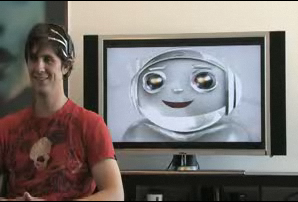
The iRobis Brainstorm® technology facilitates and accelerates the development of humanoid self-learning robots - like this little fella. HR-2 walks, talks, imitates and "evolves". He is already 3 years old by now (he was a prototype developed within 3 months with help of the early Brainstorm® system), but the video about HR-2's abilities is still worth watching. Want! [picture: Almir Heralic]
From the press release: "The Institute of Robotics in Scandinavia (iRobis) has announced that the world’s first “complete cognitive software system for robotics” is ready for application. The system turns robots into self-developing, adaptive, problem-solving, “thinking” machines. Brainstorm® automatically adapts to on-board sensors and actuators, immediately builds a model of any robot on which it is installed, and automatically writes control programs for the robot’s movements. It can then explore and model its environment. Through simulated interaction using these models, it solves problems and develops new behavior using “imagination.” Once it has “learned” to do something, it can use its imagination to adapt its behavior to a wide range of circumstances. A methodology known as genetic programming (GP) is “the trick” that makes it all possible. GP is an automated programming methodology inspired by natural evolution that is used to evolve computer programs."
You can't download their system right away - iRobis is rather looking for high-potential partners/companies/researchers with whom they can develop prototypes like toys or perhaps household robots. Please hurry - I really want some kind of little robot fella on my desktop or maybe a little bit larger so he can get me a coffee or pizza from the kitchen.
-- You can subscribe to this blog: It's about the Metaverse - 3DWeb, social web, virtual worlds, Artificial Intelligence and whatever relates to those.WEITERLESEN...
"Thanks to advances in our understanding of biology, scientists believe they can model a new generation of computers on how the brain actually works—the microscopic chemical interactions and electrical impulses that translate sensations into knowledge and knowledge into decisions and actions. It's a successor to the old ideas about artificial intelligence, and a handful of companies have initiatives under way, among them IBM (IBM) and Numenta, a Silicon Valley startup."
The Scientific American recently ran an article about the current research in neuro-technology regarding brain-machine interfaces. The first page is a little dragging, mentioning all the crazy ideas of science-fiction authors of the past 30 years, but the rest of the article is about current research programs like using the brain as an interface for prosthetics, steering through virtual worlds by mere thought or improving our memories with an artificial hippocampus. If you don't have time skip to page 4 of the article.Full article on Scientific American: Jacking into the Brain - Is the Brain the Ultimate Computer Interface?
Although we appearently still don't know jack about jacking into the brain and doing something really useful with it, there is the next best thing that you can order now (will be shipped to US addresses only by the end of the year for 299 US$): The EmotivEpoc headset taps your neurons from the outside and translates your intentions, facial expressions and emotions into commands for 3D games and virtual worlds. Their technology also lets you control a wheelchair just using mind control (video). Spooky, huh? And damn useful if it works. Here's a video showing how it works with games.
[caption id="" align="alignnone" width="249" caption="No more typing "lol" (laugh out loud)"]EmotivEpoc neuro-headset
[/caption]
Mac support is planned but scheduled for later - "the market conditions dictate that Windows comes first" is what Jonathan Geracifrom the Emotiv team told me in July. But they offer an open API set for developers so the range of supported games and virtual 3D platforms should be impressive.
Read more about the sensor-laden headset or order it now if you are living in Obama land at the Emotiv Website. (No chance for the rest of the world without US address yet)
WEITERLESEN...
Demonstration of Oblong's g-speak spatial operating environment.
Some of the core ideas are already familiar from the film Minority Report, where Tom Cruise's character performed forensic analysis using massive, gesturally driven displays. The similarity is no coincidence: one of Oblong's founders served as science advisor to Minority Report and based the design of those scenes directly on his earlier work at MIT. More about the technology: oblong industries, inc.
American cellphone subscribers for the first time sent text messages more than they phoned. Teenagers ages 13 to 17 are by far the most prolific texters, sending or receiving 1,742 messages a month, according to Nielsen Mobile. By contrast, 18-to-24-year-olds average 790 messages.
Employee training and collaboration could well become the "killer apps" for the 3-D Web, says Colin Parris, IBM's vice president of digital convergence. These online meetings do away with the huge cost and hassle of traveling to distant in-person meetings, he says.
Studies show that workers retain just 5% of what they're taught in classrooms. That figure jumps to 50% for group discussions and 70% to 90% for simulation-based training, a natural fit for the 3-D Web.
"A friendly collaboration between humans and robots is not always easy. Either robots work efficiently and far from humans in controlled environments, or they're equipped with lots of sensors to work along humans and not harm them. Now, a EU-funded project, Phriends -- short for 'Physical Human-Robot Interaction: DepENDability and Safety' -- has started to force robots to respect Asimov's laws. In a nutshell, these laws say that robots cannot cause harm to humans and that they have to obey us. This 3-year project will end next year and has received € 2.16 million from the EU. (...) The robots developed by Phriends will be intrinsically safe, since the safety is guaranteed by their very physical structure, and not by external sensors or algorithms that can fail. (...)"
If we distill the essence of change between Web 1.0 and Web 2.0, we can derive an answer. What is Web 3.0? It is the next fundamental change both in how websites are created and, more importantly, how people interact with them.
Cute virtual pet for PS3, reacting in real-time to actions in front of the in-built camera "PlayStation Eye". We are talking about consumer-friendly Augmented Reality here.
From the press release:
What makes a pet real? Introducing EyePet, the virtual pet that follows your every movement and command…(...) Working in ‘Augmented Reality’, EyePet is fully aware of people in the room and will interact with you and your environment. Place an object in front of the camera that EyePet hasn’t seen before and it’ll know exactly what to do with it, give it something new and it’ll examine it thoroughly. Tickle it by waving your fingers in front of the camera: it laughs, poke it: it jumps, roll it a ball: EyePet chases around the screen after it. (...)
WEITERLESEN...
“Teens and tweens are making more and more of the purchase decisions, or at least influencing that decision. Mom already knows that Sears provides trusted value and quality, but we need to prove to the teens and tweens that we have the apparel and styles to help them “arrive” at school this year with confidence” —
Watch more than the first 30 seconds, because you’ll think this is clearly a fake (*) until you realize that those camera movements are simply not possible in real life. Later on they show avatars, lightning and embedding of all ther media like pics and movies etc. just with a click on the wall. Dusan Writer asked: What IS this??
UPDATE: Techcrunch: “little is known about LivePlace, other than that the WHOIS lists the domain’s owner as Brad Greenspan, one of the co-founders of MySpace. Note: It appears that in the 20 minutes since Techcrunch spoke to Greenspan about this post, someone was told to take LivePlace down (apparently nobody was supposed to find it)."
*) UPDATE #2: In fact there was discussion that the first 30 seconds were stolen from a different (pre-rendered) design project.WEITERLESEN...
Image via Modern Life is Rubbish. Edge’s recommendation of a really great scifi story by science historian George Dyson, brother of techbiz genius Esther Dyson. Greetings from Douglas Adams, too…. Jump into the story right away: Engineer’s DreamsWEITERLESEN...
Nice blog post about all the buzz (quoting Rosedale, Linden Labs founder) and I couldn’t agree more. It’s about facilitating collaboration in an ever-changing, globalized and internationalized (business) world and about using modern bandwidth and technology in order to reduce travelling time and costs, cultural barriers and borders. And, additionally, about fun. Always :-)
WEITERLESEN...
Like I predicted a week ago (yeah I know, that’s lame :-)), the serious papers are picking up the discussion and development that was stirred by the launch of Google’s Lively and a couple of other web-based virtual world clients in the new media blogging scene. From the article: “The allure of the 3D Internet is easy to see. What auto maker would be content to put 2D pictures of a new SUV on its Web site when it can offer buyers a virtual, first-person drive down a snowy mountain road? What sculptor will want to display 2D photographs of her work when she can invite collectors on a guided tour of her virtual sculpture garden?”
WEITERLESEN...


![Bill Diodato, Scientific American]](https://lh3.googleusercontent.com/blogger_img_proxy/AEn0k_vy9D1nmFEp87u41jvyncGBdR53AsoLv__OaFb5MdcrfI93G-PFh7Bh_SUyXw-ZHYJyrhZ1hb9TXjqhHsDv1lt6IFB-pISKkURDZqNT5n1VX47fityO8KG5u3SmCPDmxxtlGUdmsL-FhuU1JMGk=s0-d)

 [/caption]


 Gaby K. Slezák
